Uyut Remont — apartment renovation company website
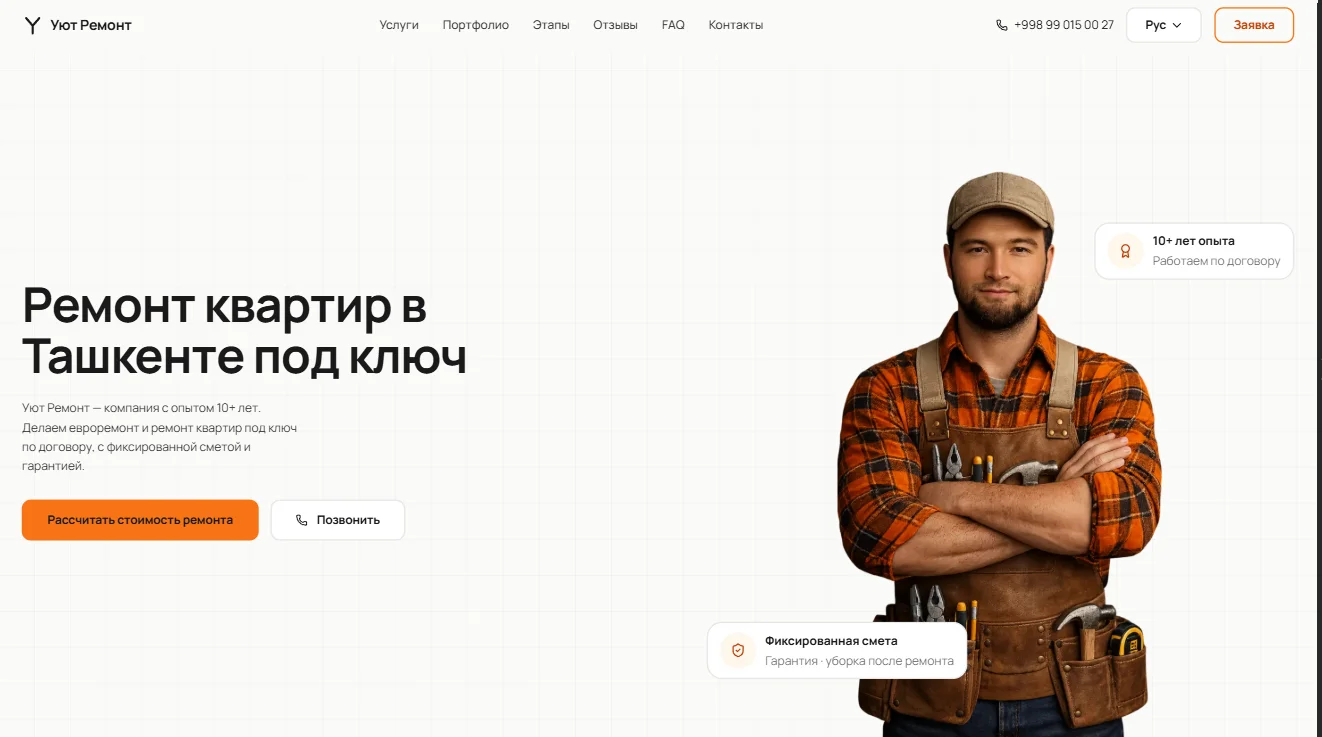
We built an apartment renovation company website for Uyut Remont in Tashkent: six priced services with their own pages, a before-and-after portfolio and a request form that lands straight in Telegram. Renovation requests grew by 51%.
Challenge
Uyut Remont is a Tashkent company that handles cosmetic and major renovations, euro-style renovations and turnkey apartment projects, plus tiling and painting. It works under a contract with a fixed estimate, staged payments and a 12-month warranty, and the team has more than 10 years of experience, including projects in Europe, Canada and Kazakhstan. Its clients are apartment owners across Tashkent's districts.
Anyone planning a renovation worries about the same things: a crew that disappears halfway through, an estimate that keeps growing and tradespeople who never pick up the phone. The apartment renovation company website had to ease those worries before the first call. It needed to present Uyut Remont as a company with a name, a contract and a warranty rather than a crew found through a classified ad, and to do it on the first screen, before a visitor goes back to the search results. Saying “reliable” is not enough: it takes concrete promises and figures.
The second question is price. The cost depends on the condition of the apartment and the scope of work, yet people want a sense of the numbers before anyone comes to measure. The site had to show starting prices for each of the six services, from painting to a major renovation, and explain plainly that the exact estimate is made on site, fixed in the contract and does not change as the work goes on. On an apartment renovation company website, each service also needed its own place for the scope of work, timelines and common questions. A client should see what they are paying for before meeting the foreman.
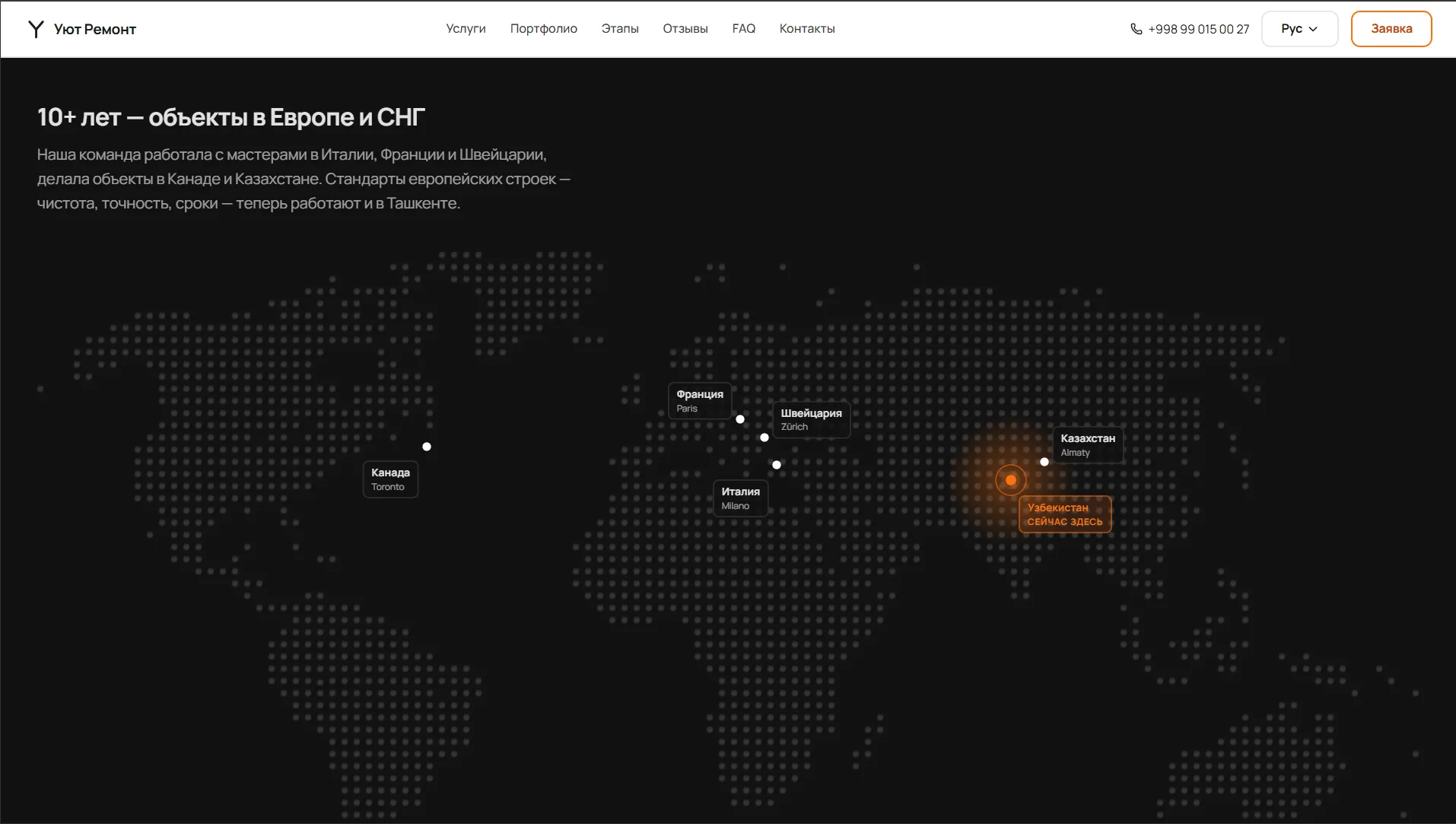
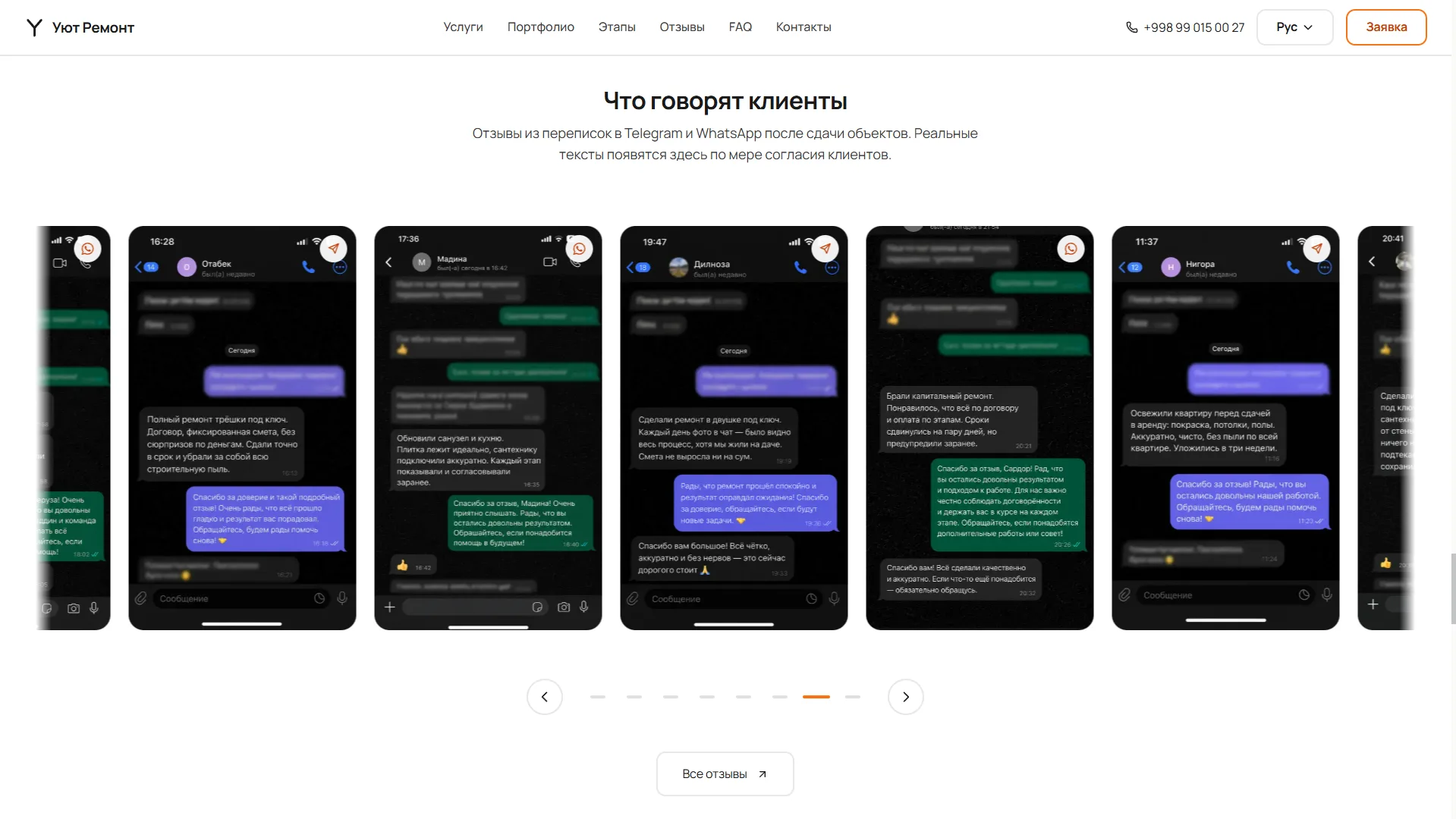
A renovation is judged by its result, and photos of finished rooms prove little: they don't show what the apartment looked like before, how long the job took or where it is. The proof had to take another form: before-and-after comparisons with the district, floor area and timeline, a clear step-by-step process and an account of where the team has worked before. Feedback on renovations usually arrives in messengers, so it made sense to show reviews as chat conversations rather than anonymous quotes. Each project also had to open as its own page with a description of the work.
Finally, requests come in by phone, WhatsApp and Telegram, and people search for specific jobs such as tiling or painting in Tashkent rather than for a company name. The site had to accept a request through any channel, and a request from the form could not get lost: it had to reach the team right away, in the place where they already talk to clients. Two more conditions applied: three languages, Russian, Uzbek and English, and a separate page for every service that a search engine sees in full right away. All of it had to launch within a week.
Solution
We built the apartment renovation company website as an answer to the client's fears: every block closes one question — price, proof, process or contact.
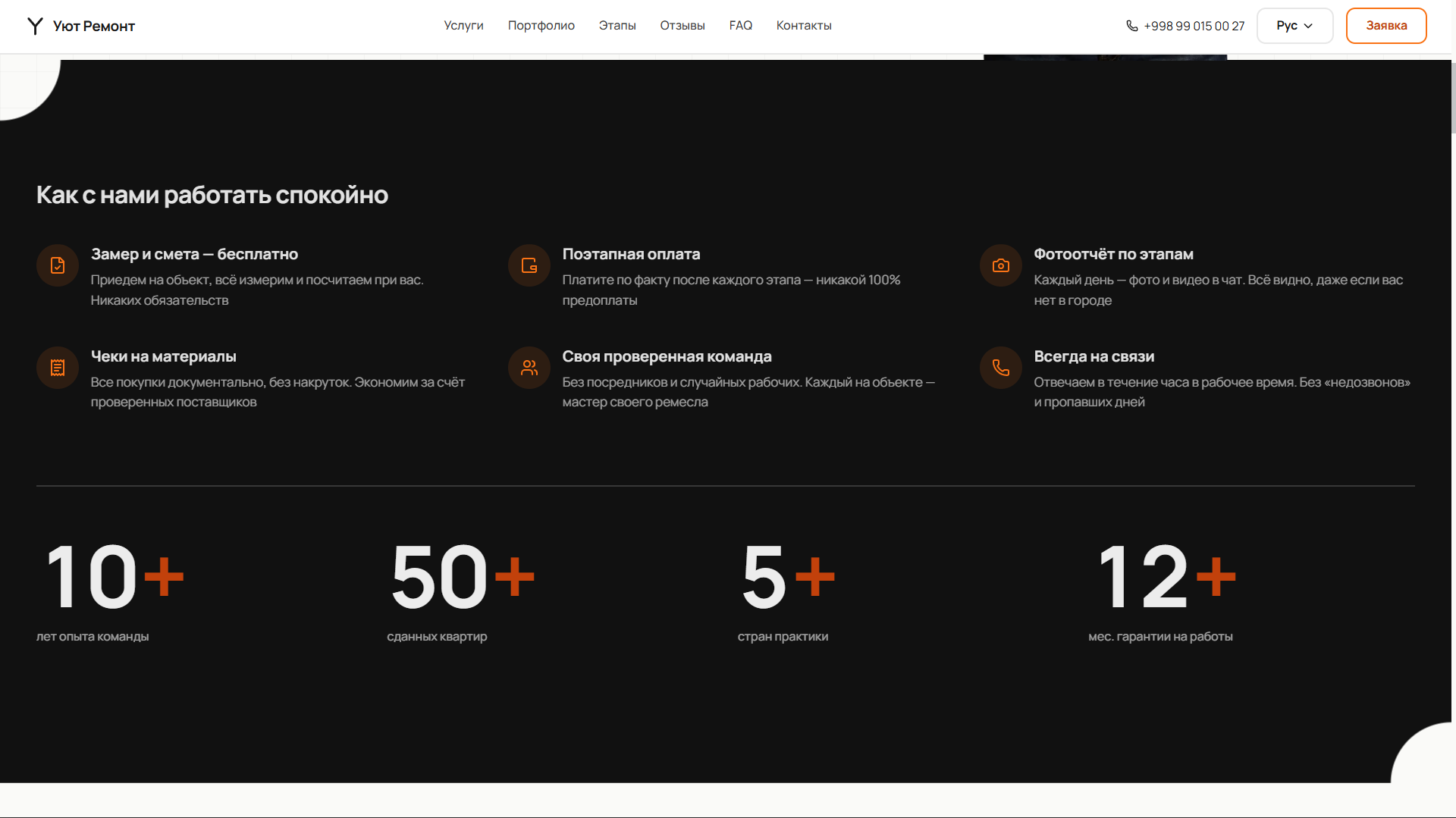
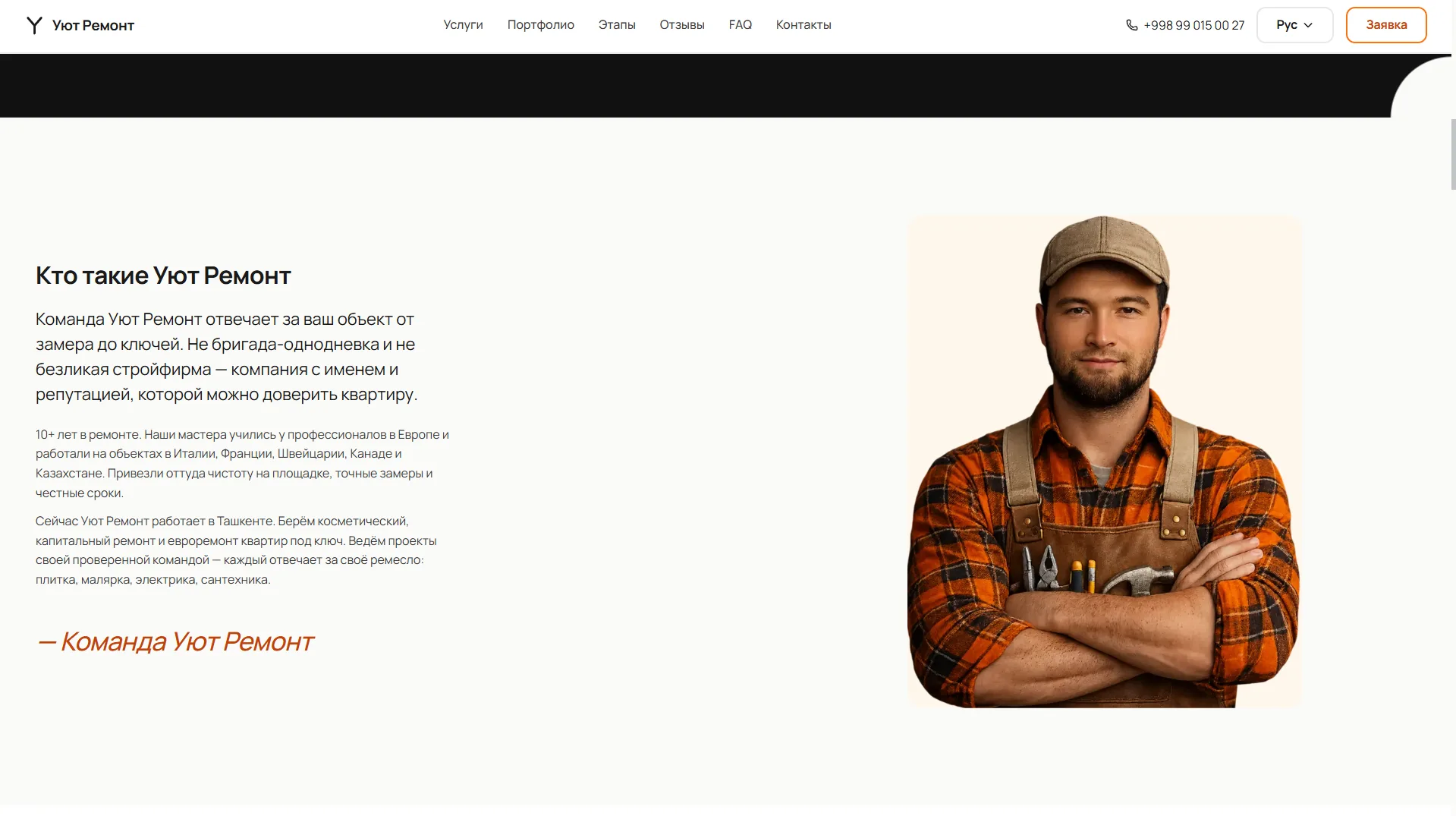
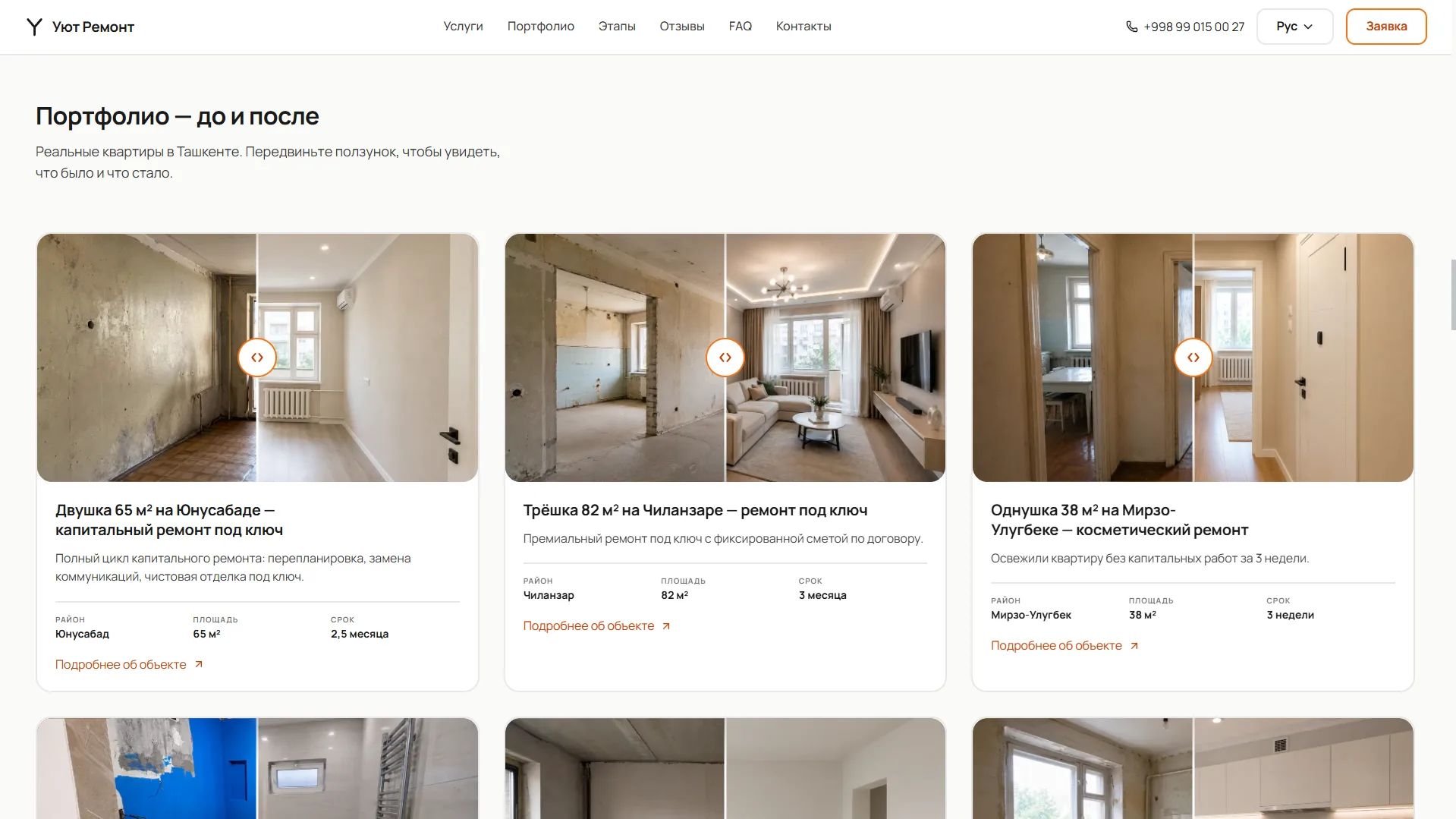
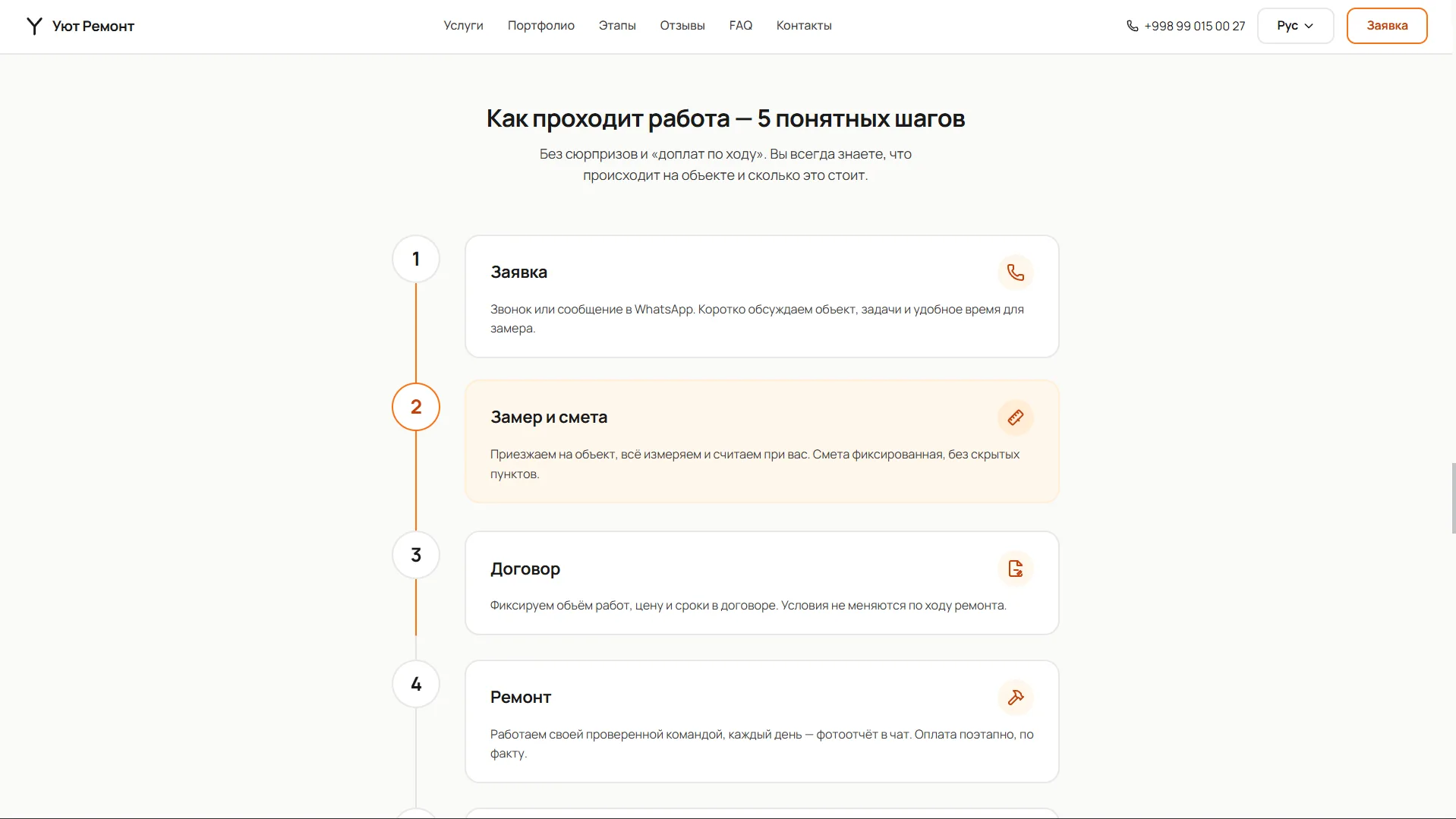
The home page has ten blocks: a first screen with 10+ years of experience, work under contract and a fixed estimate, six promises with counters, the team story, priced services, the portfolio, a map of experience, five steps, reviews, common questions and the form. The promises and counters come right after the first screen, so trust comes before prices. Each of the six services has its own page with the scope of work, the price, three questions and related services. The portfolio compares apartments with a before-and-after slider and links to a project page with the district, area and timeline.
The interface is written in React and TypeScript, and the animation, from page transitions and dialogs to block reveals and counters, runs on Framer Motion and GSAP. Each of the 33 pages, 11 sections in three languages, reaches the browser ready-made: people and search engines see it at once, and the markup tells search engines it is a company with services, prices and answers to common questions. The form goes to a Vercel server that checks the fields, filters out bots and forwards the request to Telegram. Lighthouse on desktop gives the home page 99 for performance and 100 for accessibility and SEO.
Six services, six pages
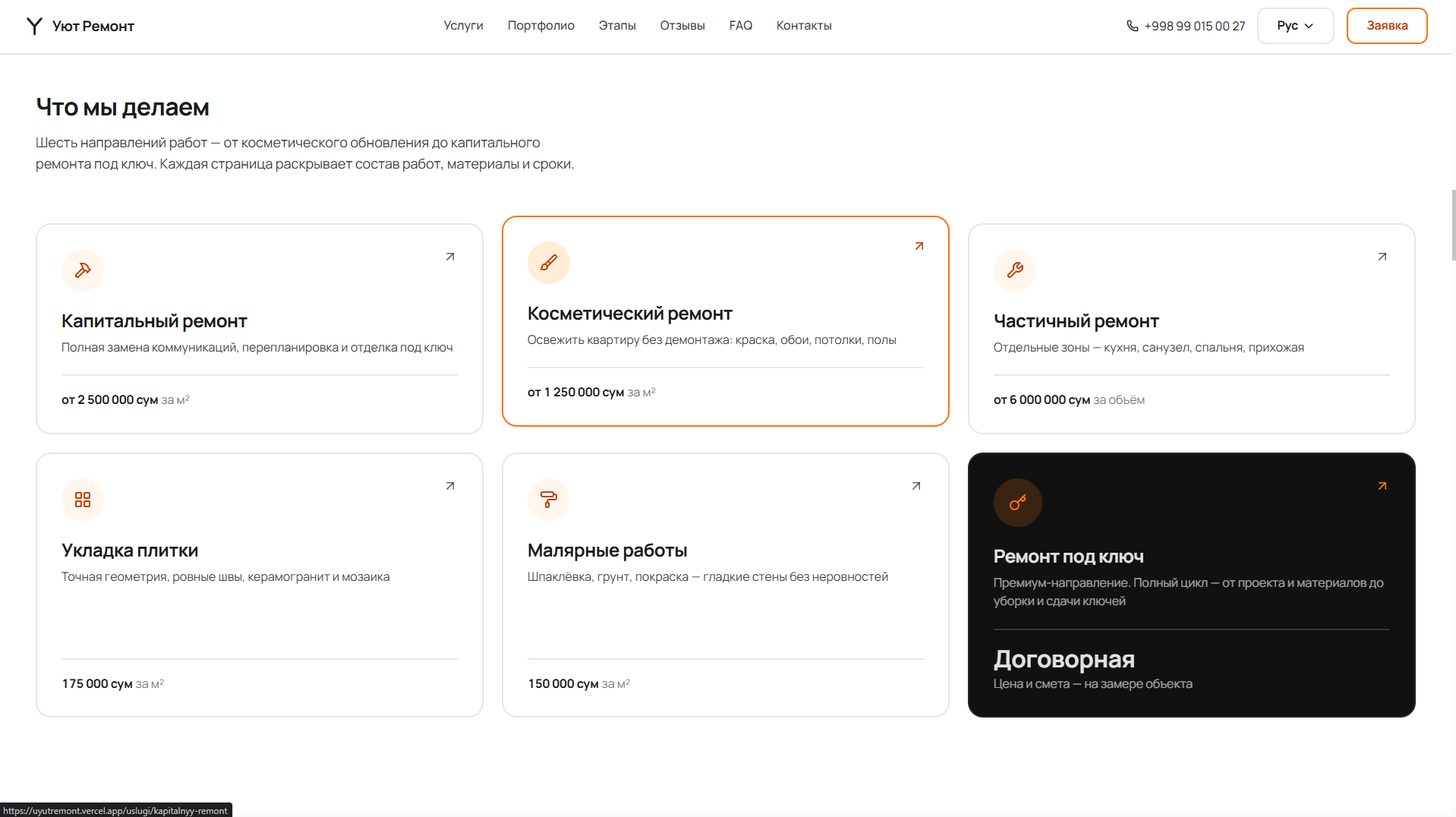
Major, cosmetic and partial renovation, turnkey work, tiling and painting each sit on a card with a price, from 150,000 UZS per m² for painting to 2,500,000 UZS per m² for a major renovation. Every service has its own page with what the work includes, three common questions and links to related services, so someone searching for one specific job lands on the right page.
Before-and-after portfolio
Projects in the portfolio come with a slider that reveals the apartment before and after the renovation. Each card shows the district, area and timeline, and every project has its own page describing the work, with a selection of similar projects. A client compares their own situation with a similar apartment instead of glossy pictures.
Promises, figures and five steps
The “How working with us stays predictable” block gathers six promises: a free measurement and estimate, staged payment, a daily photo report, receipts for materials, an in-house crew and a reply within an hour. Below are counters for 10+ years, 50+ apartments, 5+ countries and a 12-month warranty, and the client's path is laid out in five steps, from the request to handover with cleanup. So the client knows in advance when and what they pay for.
Requests that land in Telegram
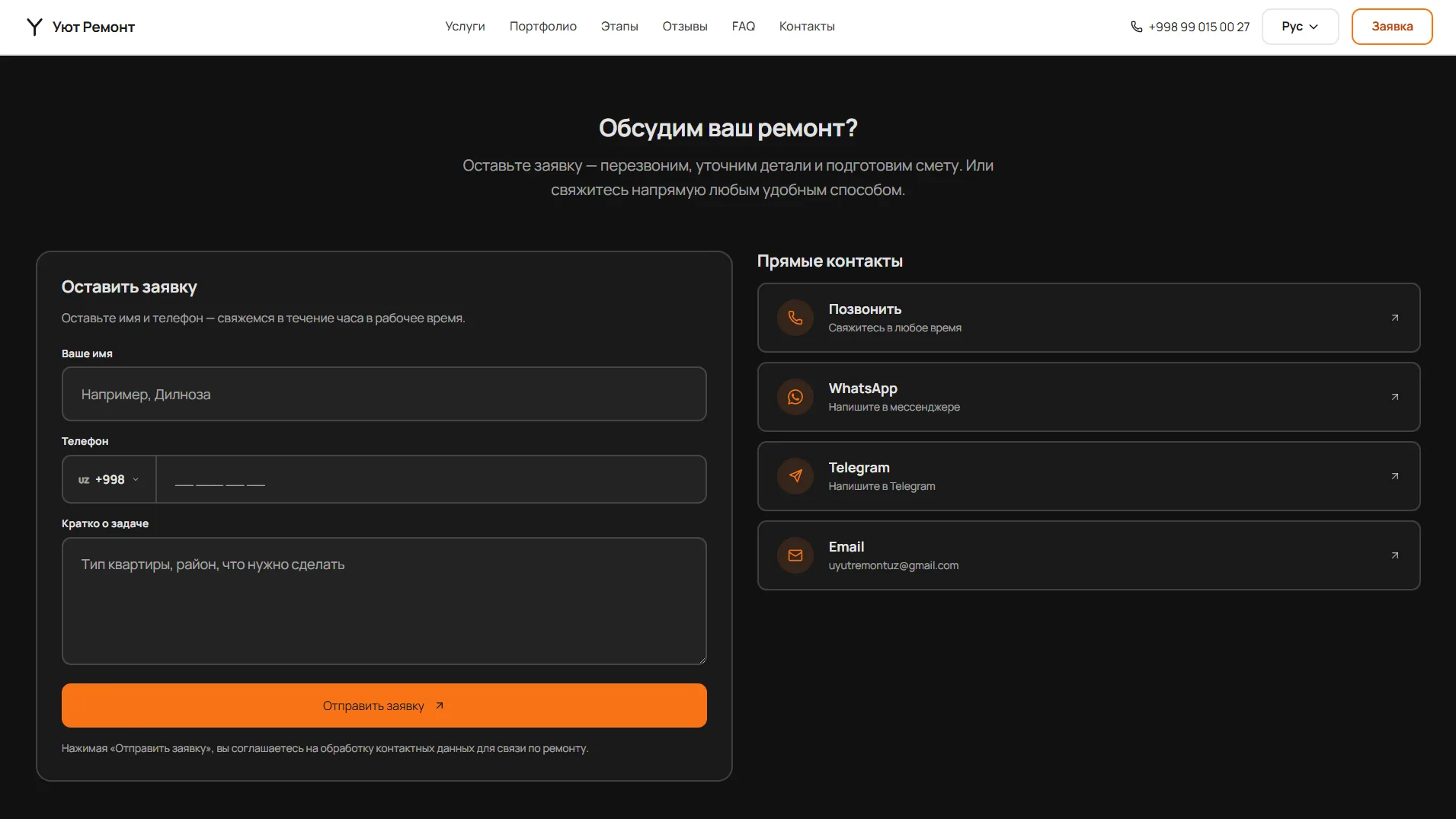
The form asks for a name, a phone number with a country code picker and a few words about the job. The server checks that the name and phone number are valid, filters out bots and rapid repeat submissions, and only then forwards the request to the team's Telegram. Next to the form are direct channels — call, WhatsApp, Telegram and email — with a choice of the main or backup number, and on phones these buttons stay in a bar at the bottom.
Reviews and common questions
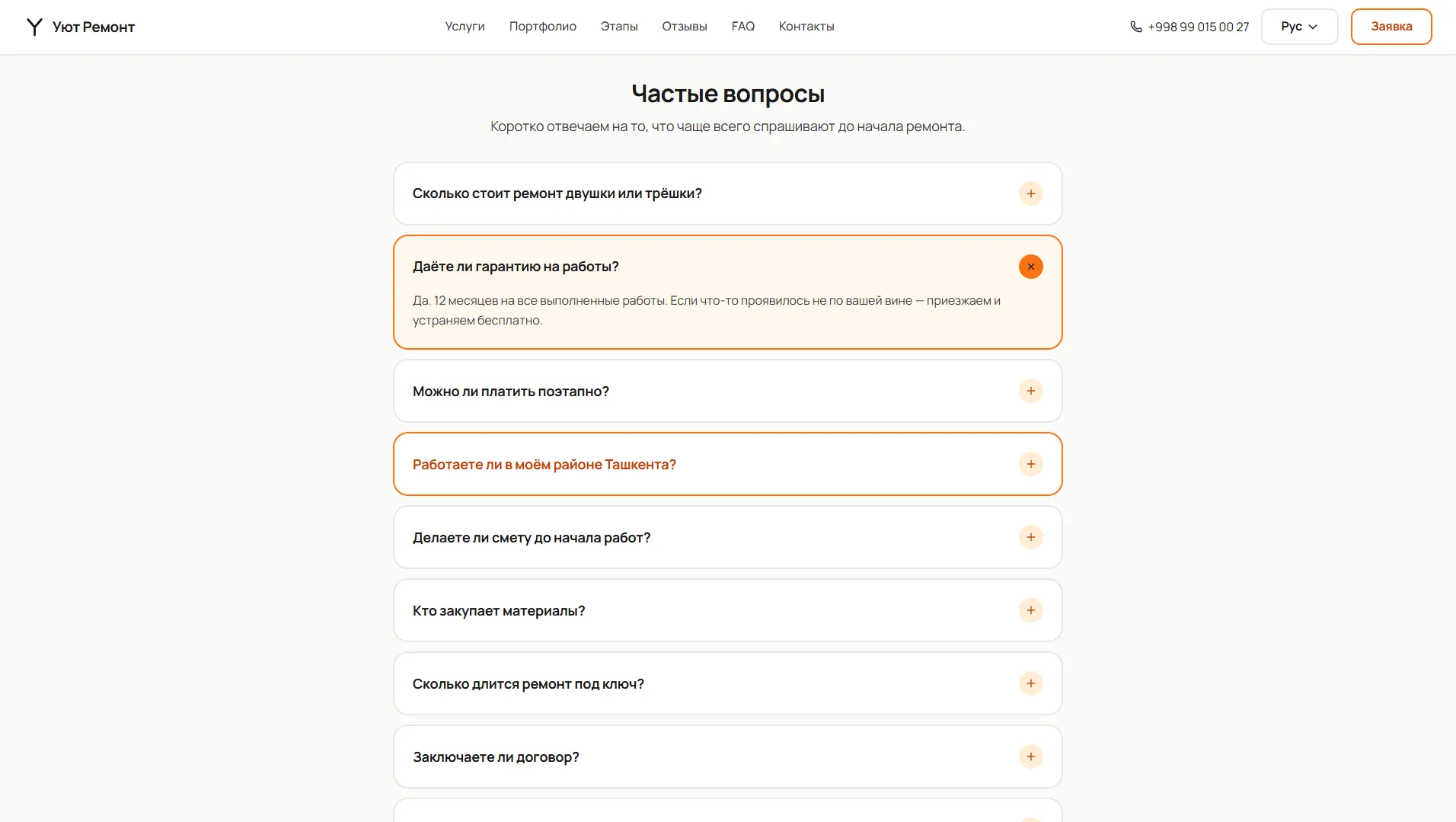
Reviews are shown as Telegram and WhatsApp chat screenshots: the cards scroll in a carousel and open full size. Nine common questions cover what people ask before a renovation starts: the price of a two- or three-room apartment, the warranty, staged payment, who buys materials, timelines, the contract and what a euro-style renovation means. Answers open one at a time, so the page stays light.
Three languages, 33 ready pages
The Russian, Uzbek and English versions live at their own addresses — /uslugi/, /en/services/, /uz/xizmatlar/ — and switch from the header. Each of the 33 pages reaches the browser ready-made, with a title, a description and markup that tells search engines what the company is, which services it offers at what prices and how it answers common questions. So both people and search engines see the whole page, even before the scripts load.
Results
The project's key outcomes in numbers.
- +51%Renovation requests
Renovation requests grew by 51% after the new website went live.
- 6Services with own pages
Major, cosmetic, partial and turnkey renovation, tiling and painting, each with a price and a scope of work.
- 33Pages in three languages
Eleven sections in Russian, Uzbek and English, each page with its own address and fully visible to search engines.
- 7 daysFrom start to launch
The three-language site with a portfolio and a request form that goes straight to Telegram went live in seven days.
Design & interfaces
Key screens and interfaces of the project.
Project tech stack
The stack we used to build the solution for the client's task.
- Vercel
- TypeScript
- React
- Sass
- GSAP
- Vite
- Framer Motion
- MobX
- React Router
- Telegram Bot API
Ready to become the next case?
Tell us about your task — a manager will assemble the team, calculate the estimate and send a proposal within the first hour after the request. No obligations, no drip campaigns.