CALLONE — loyalty app for installers and sellers
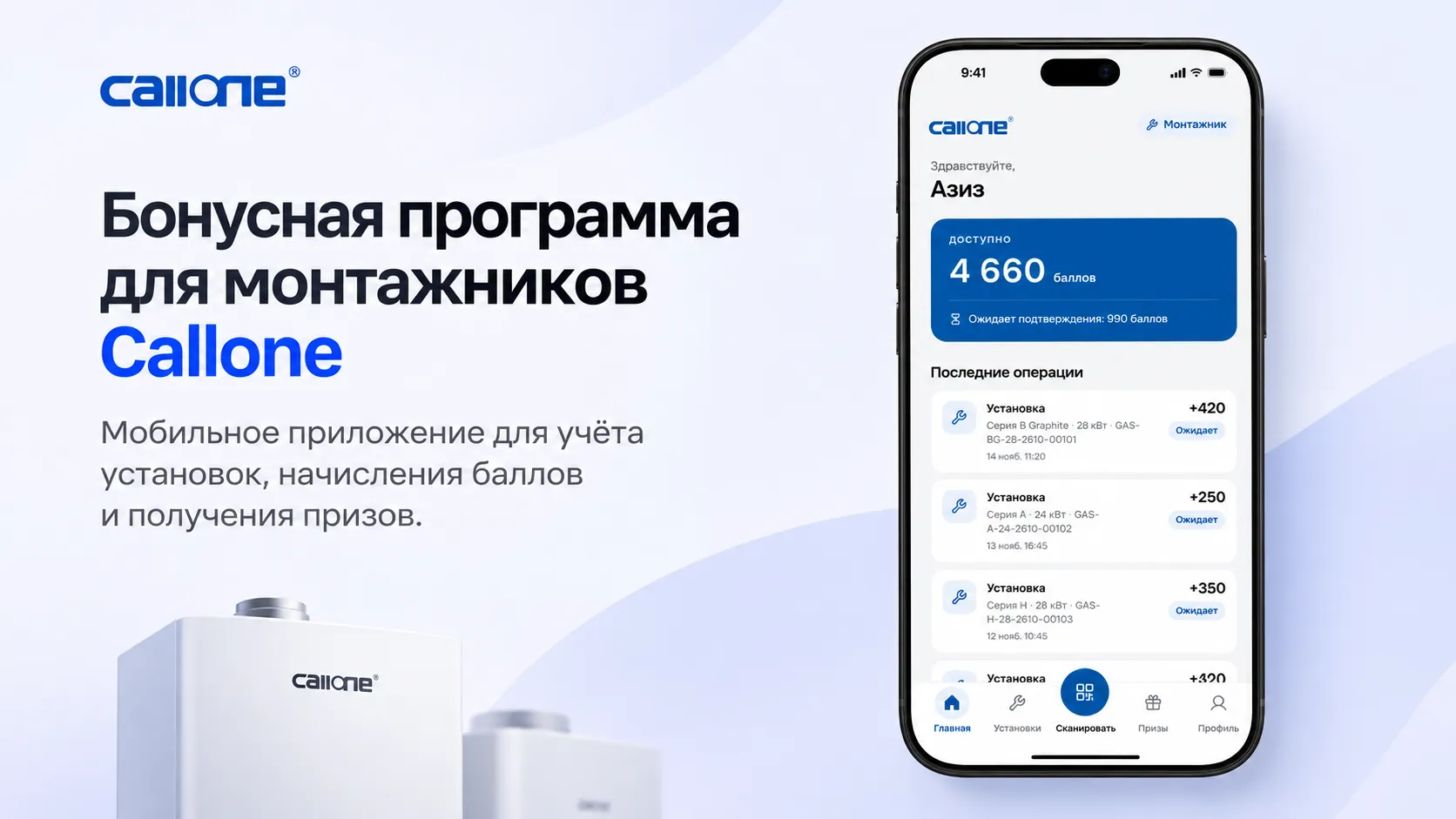
We designed a loyalty app for CALLONE installers and sellers: they scan the QR on a boiler, register a sale or installation and earn points. The buyer confirms with an SMS code, and the service team gets a base for the first start-up.
Challenge
CALLONE sells gas and electric boilers and gas water heaters for homes in Uzbekistan. Shops sell the boilers, installers put them in, and after installation the CALLONE service team carries out the first start-up free of charge. To do that, the company needs a customer base: who installed which equipment and where.
CALLONE already has a catalog website for buyers, but from there a boiler reaches people through shops and installers all over Uzbekistan. For the service team to call a buyer and carry out the free first start-up, the company needs a base: who installed which equipment and where. Only the people who actually handle the boiler can build it: sellers and installers. So the client chose a loyalty program: a QR sticker on every unit, a scan at the sale and at the installation, points for confirmed actions and rewards for points. The points are not the goal but the reason to enter data honestly and in full.
The hardest part was honest data. If points are paid for the scan itself, the program fills up with installations that never happened, borrowed photos and buyers with made-up numbers. An installer could “confirm” a friend's installation, a seller could “sell” a boiler that is already installed, and one sticker could be used twice. Every such loophole had to be closed by rules on the server and in the database rather than by trust. At the same time, an honest partner's work could not turn into paperwork: the whole flow next to the buyer has to go without extra steps, and a repeated tap on a weak connection must not create a second record or second points.
The law and the job site set the constraints. Personal data of buyers and partners is stored only on servers in Uzbekistan, so the app uses no cloud services such as Firebase, no cloud analytics and no crash reporters, and therefore no push notifications. An installer works on site, wearing gloves, in poor light and sometimes with a weak signal. The interface had to be in Russian and Uzbek, the app had to run on Android and iOS, and the data had to come from the same server that already serves the website and the admin panel. Buyer SMS messages go out in Latin script, which fits 160 characters into one message instead of 70. Account deletion inside the app had to be planned before release, since Apple and Google require it.
There are two kinds of users: installers register installations with the buyer's details, and sellers record sales. The buyer never installs the app and only gets an SMS with a code and a message that the warranty is active. For the client, success looked like this: every installation is confirmed by the buyer, the service team gets a first start-up task right away, partner points become available only after the service visit, and the warehouse imports serial numbers from Excel and prints 58×40 mm stickers on a thermal printer on its own. Managers see installations with photos and a map link, and the service team gets a task list with the buyer's address and phone.
Solution
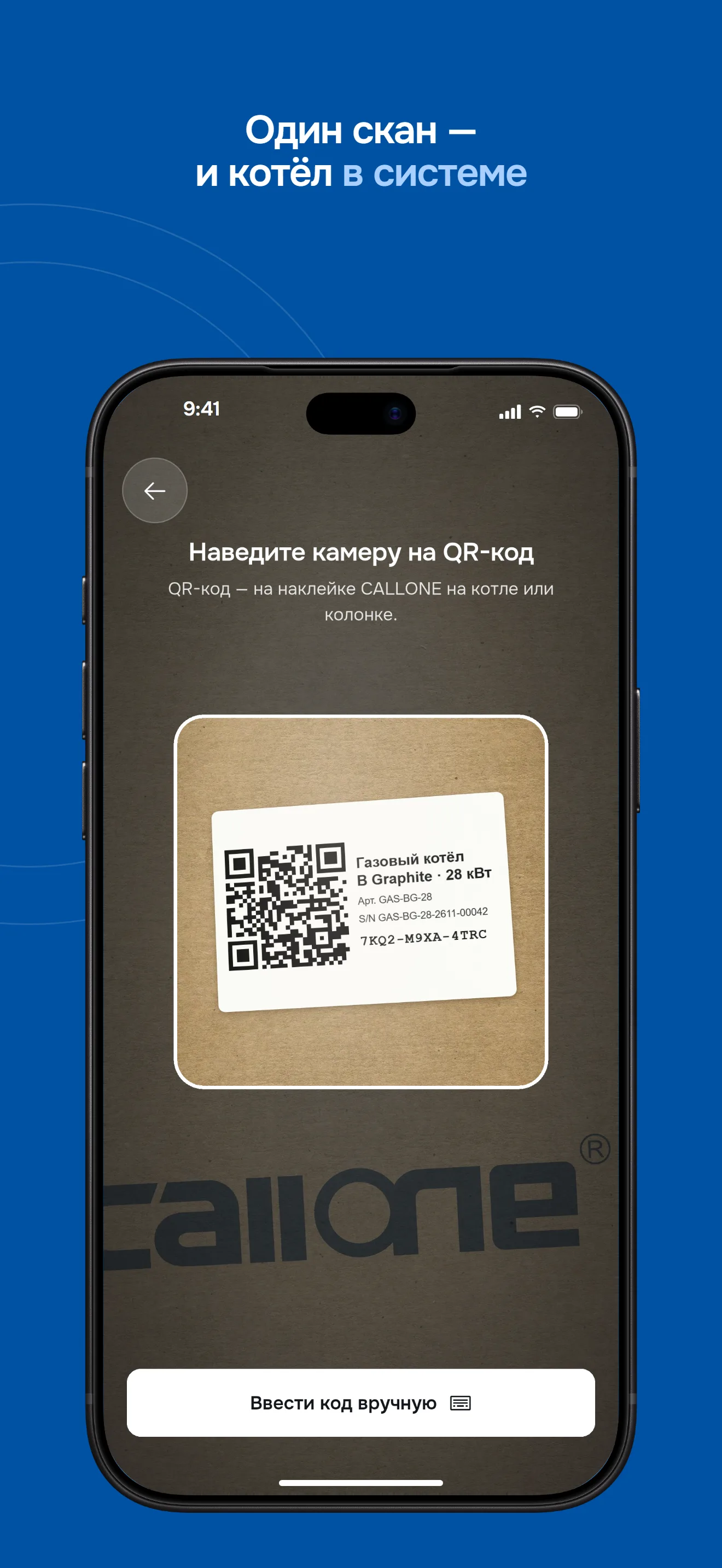
We designed the app around one action, scanning the QR sticker: sales, installations, points and rewards all start there, and every rule is checked on the server.
A partner signs in with a phone number and a code sent to Telegram, and on the first sign-in chooses a role: installer or seller. The home screen shows the balance (available and pending), a big “Scan” button and the five latest operations. The scanner works with the camera and the flashlight, and if a sticker is damaged, its 12-character code can be typed in by hand. Next comes the equipment card with the model, power and serial number, plus an action button for the partner's role or the reason the action is unavailable. The bottom bar reads Home, Scan, Rewards, Profile. Without a connection, the app says so plainly and offers to retry.
The Flutter app runs on Android 8.0+ and iOS 15+ from one codebase and does without extra third-party libraries. Data comes from the same C++ server (Drogon) that serves the website: models and options come from the site catalog, and Telegram code sign-in through Telegram Gateway already works there. The sticker holds a link to the site's domain, so a regular phone camera opens the model page, while the app accepts only its own links. CALLONE staff manage partners, stickers, installations, service visits and rewards in the same React Admin panel as the catalog.
Sign-in with a Telegram code
Partners have no passwords: just a phone number and a six-digit code delivered to Telegram. The code is valid for 5 minutes, allows 5 attempts and is never stored on the server in readable form. This sign-in already works on the server, and we kept SMS for buyers. If a number has no Telegram account, the app shows the support phone, and a blocked partner sees a block screen at once.
Installations with photos and location
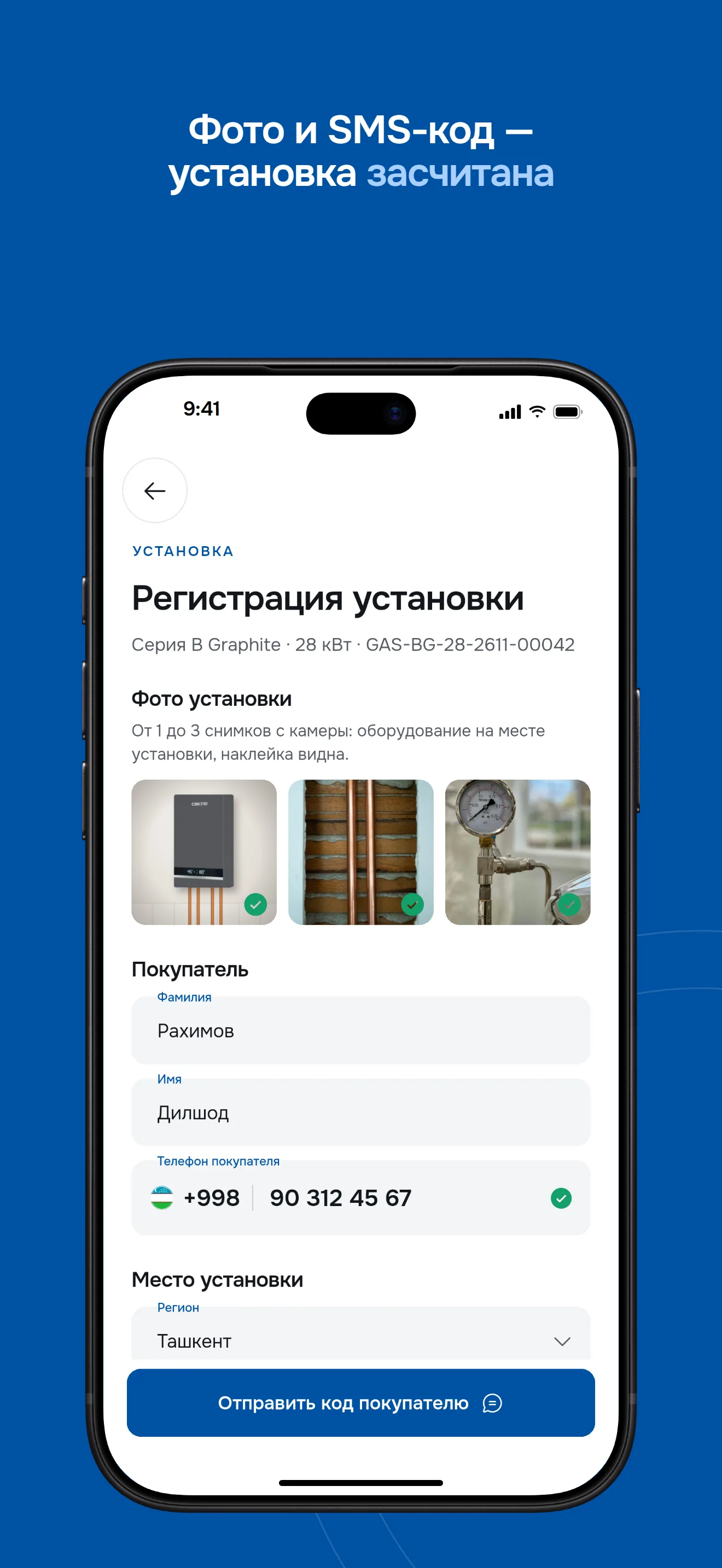
The installer takes one to three photos with the camera only: picking from the gallery is closed, so nobody can submit someone else's photo or a catalog picture. Every photo is tied to the person who uploaded it. Coordinates fill in automatically; if location access is denied, the installation still goes through, and the admin panel shows it. Each shot is scaled down to 1024 pixels on the phone, so it uploads quickly even over mobile data.
The buyer confirms with a code
Once the form is sent, the buyer gets an SMS with a six-digit code and tells it to the installer. The code is valid for 10 minutes and can be resent after 60 seconds, no more than three times. The buyer's phone cannot belong to any app user, so installers cannot confirm installations for each other. After confirmation, the buyer gets an SMS saying the warranty is active.
Points only after the service visit
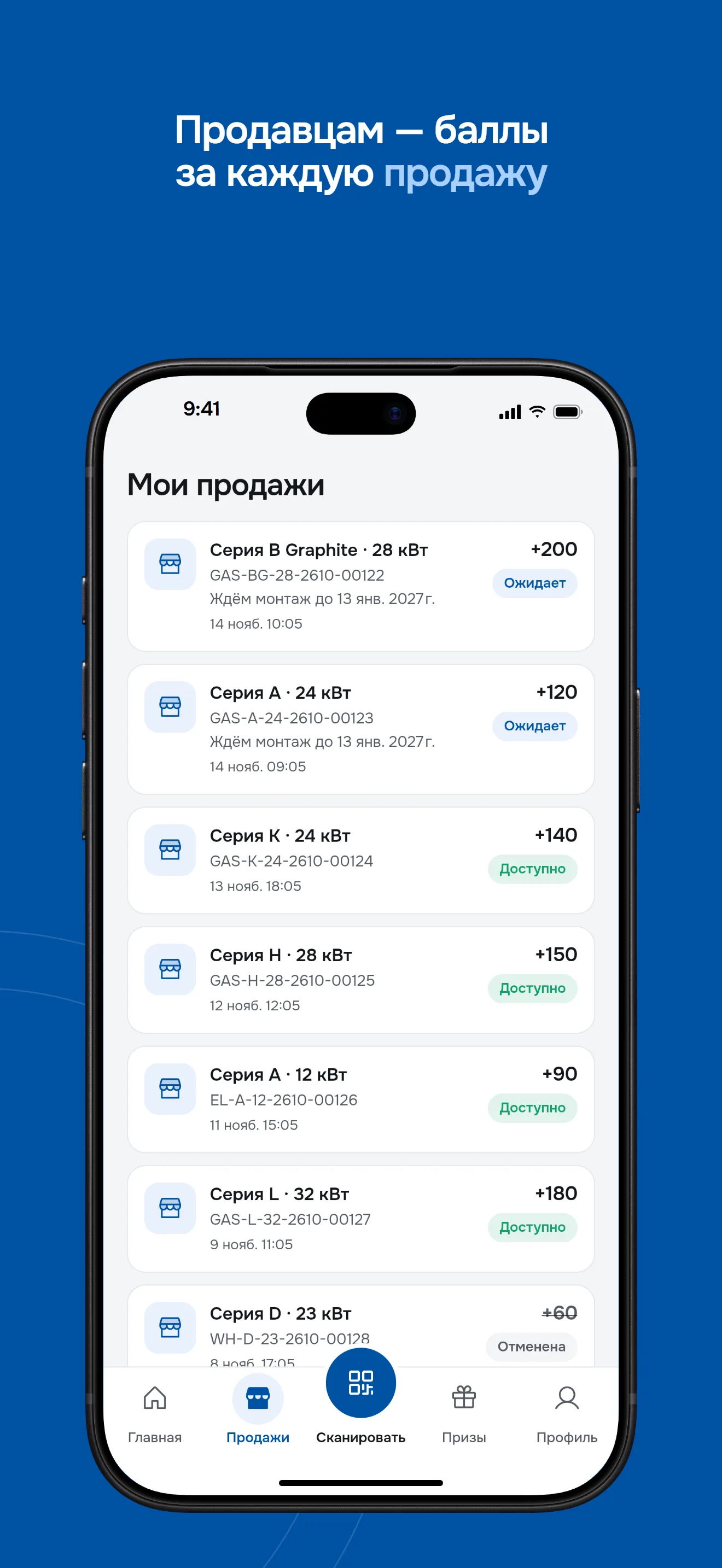
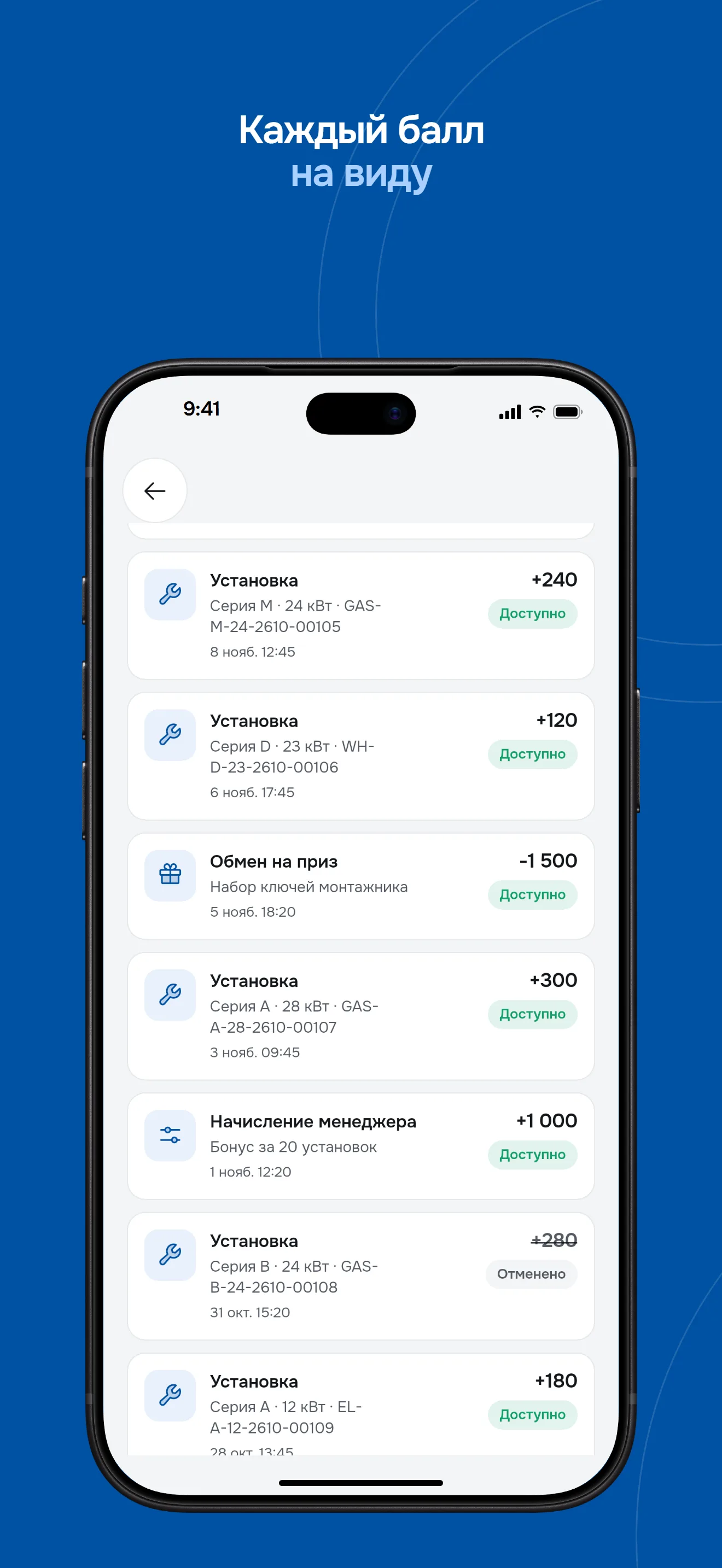
Sales and installations earn points, but first as “pending”. They become available when the service team marks the first start-up as done or a manager approves a sale by hand. A unit can be sold and installed only once, an installed boiler cannot be sold, and a double tap never credits points twice. Only a manager can cancel an operation, and its points are cancelled with it.
Rewards, history and profile
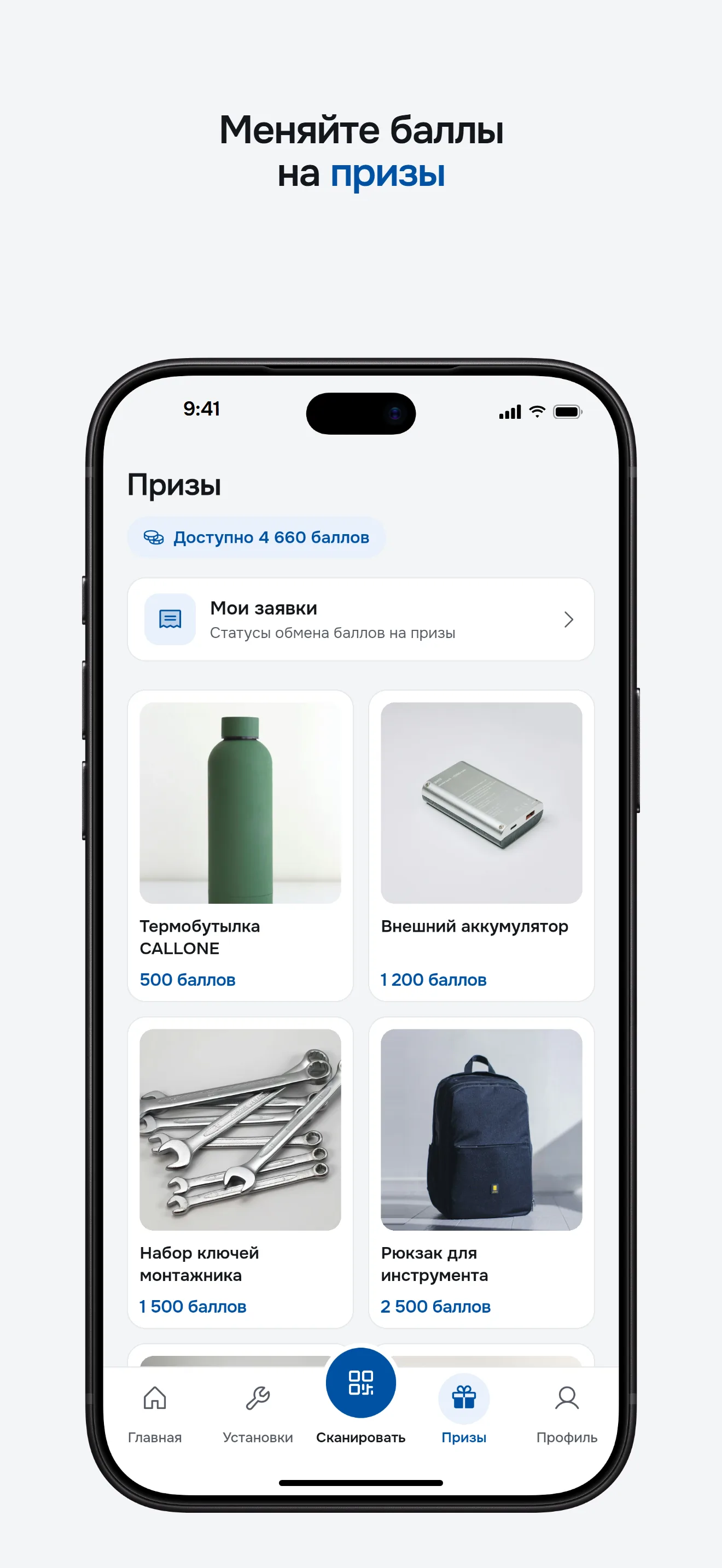
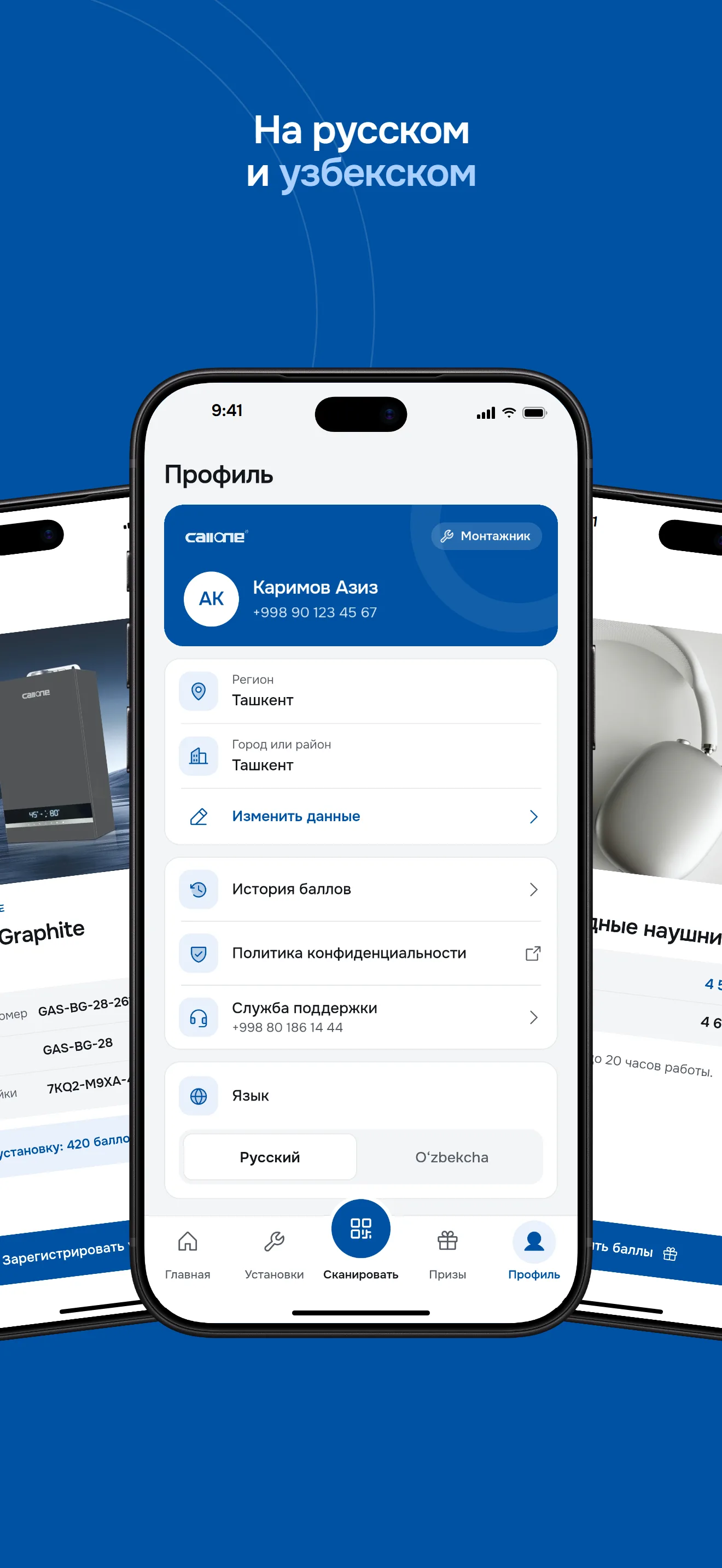
In Rewards, a partner picks a reward and exchanges points for it: they are deducted at once, a manager takes the request through to handover, and a rejection returns the points. There is an operations history with statuses, My installations and My sales lists, and a profile with language, policy, support phone, sign-out and account deletion. A deleted account is anonymized, while its installation history stays.
An interface for the job site
Installers work in gloves and poor light, so buttons and fields are at least 56 dp, about 9 mm on screen, the main action is a full-width button at the bottom, and statuses use both color and text. Animations are short and never delay input. A denied camera or location permission doesn't crash the app: it explains why access is needed and opens settings. The Telegram code can be pasted from the clipboard, and a timer shows when to ask for a new one.
Results
The project's key outcomes in numbers.
- 15App screens
From language choice and sign-in to the scanner, installation form, points, rewards and profile, all as set in the spec.
- 2Platforms: iOS and Android
One app for Android 8.0+ and iOS 15+: both versions are built from shared code.
- 2Interface languages
Russian and Uzbek in Latin script with every text in both languages, and buyer SMS messages in Uzbek Latin.
- 1Catalog for site and app
The app takes models and options from the website's catalog, and the points for each option are set there too, in one admin panel.
Design & interfaces
Key screens and interfaces of the project.
Project tech stack
The stack we used to build the solution for the client's task.
- C++
- Drogon
- PostgreSQL
- Dart
- Flutter
- React Admin
- Telegram Gateway
Similar cases
Ready to become the next case?
Tell us about your task — a manager will assemble the team, calculate the estimate and send a proposal within the first hour after the request. No obligations, no drip campaigns.