Mikond — designer chandelier catalogue website
We built a catalogue website for Mikond's designer chandeliers: each piece has a page with its project story and photos, and the order button leads to a messenger or a call. Visitors now view 44% more pages, and bounce rate fell by 35%.
Challenge
Mikond is a Tashkent brand of premium chandeliers made to order from the client's dimensions and sketches. Its pieces hang in mosques, the Centre for Islamic Civilisation, a bank lobby, restaurants, the NG Hotels lobby and private homes, and its partners include Wyndham, Hilton, Uzum and Trast Bank.
At the heart of Mikond are chandeliers created for a specific space, whether a prayer hall, a hotel lobby or the stairwell of a private house. That is why a designer chandelier catalogue website could not be an ordinary storefront with prices and a basket. Every piece had to be presented as a finished project: where it hangs, how it is built and what impression it makes.
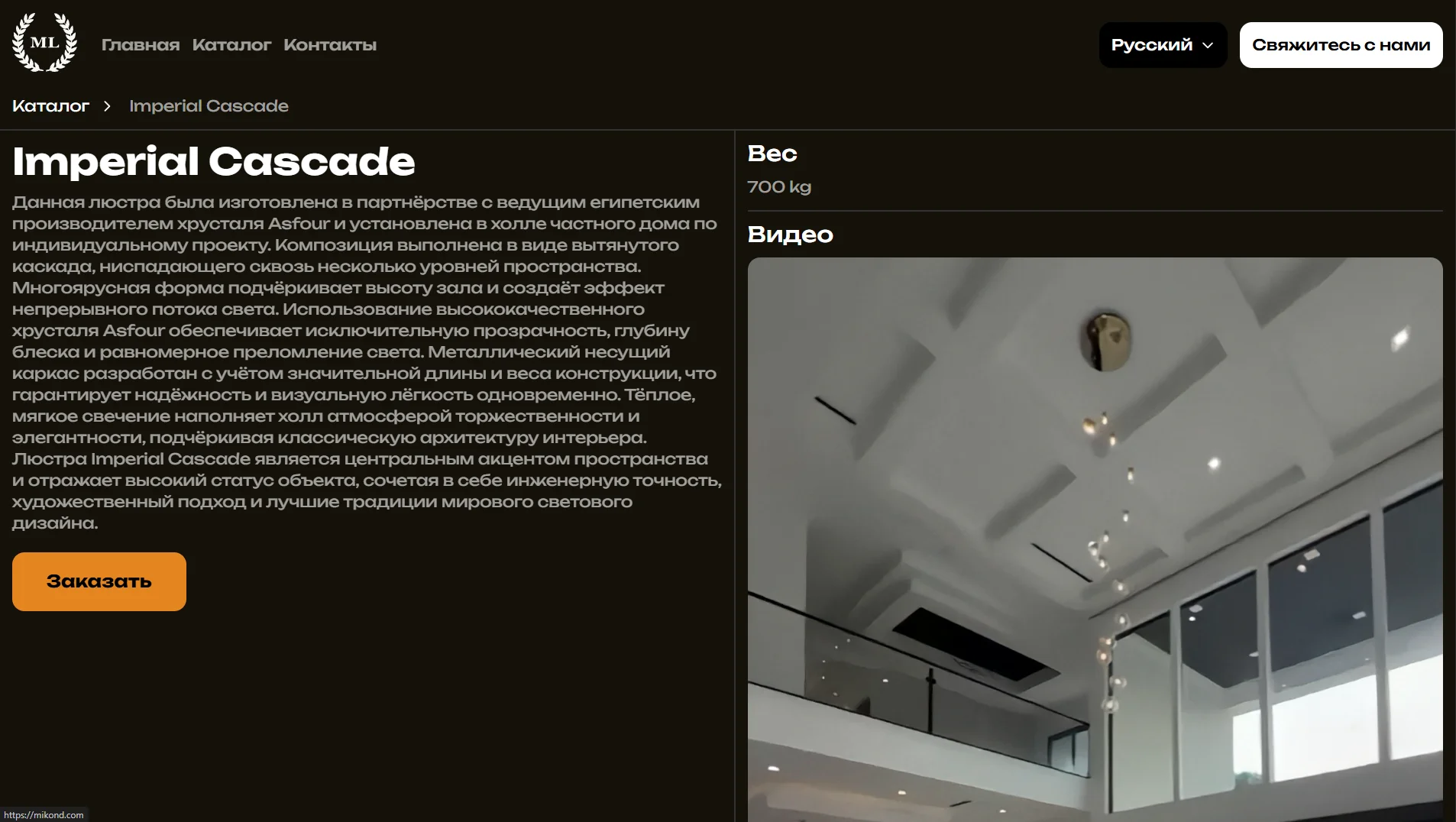
A single photo rarely conveys the scale of such work. A cascade falling through several floors of a house, or a 700 kg composition, only makes sense in context, next to a video, the specifications and the story of the site. Without that, a premium piece gets lost on screen among random pictures from the internet.
An order for such a piece begins with a conversation about dimensions, sketches, timing and installation. That conversation is easier in a chat or on the phone than through a form on a website, so the path from a chandelier someone likes to a live dialogue had to take a couple of taps on both a smartphone and a desktop.
The brand's audience is broad: private clients, restaurants, hotels, banks and public institutions whose logos sit in the partners section. The interface was needed in Russian, Uzbek and English, and the catalogue had to stay alive, with new projects going live without a programmer's help.
Solution
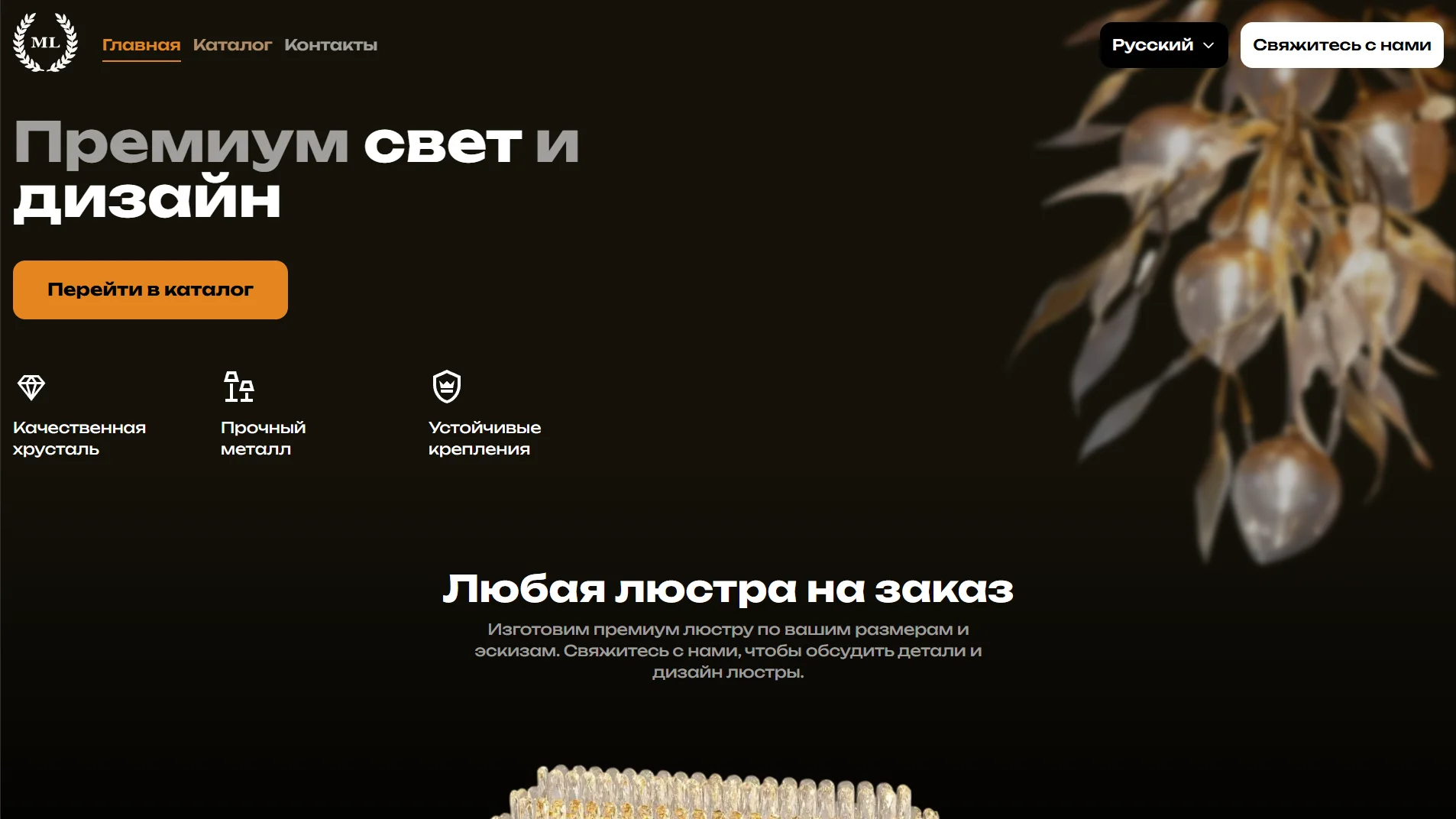
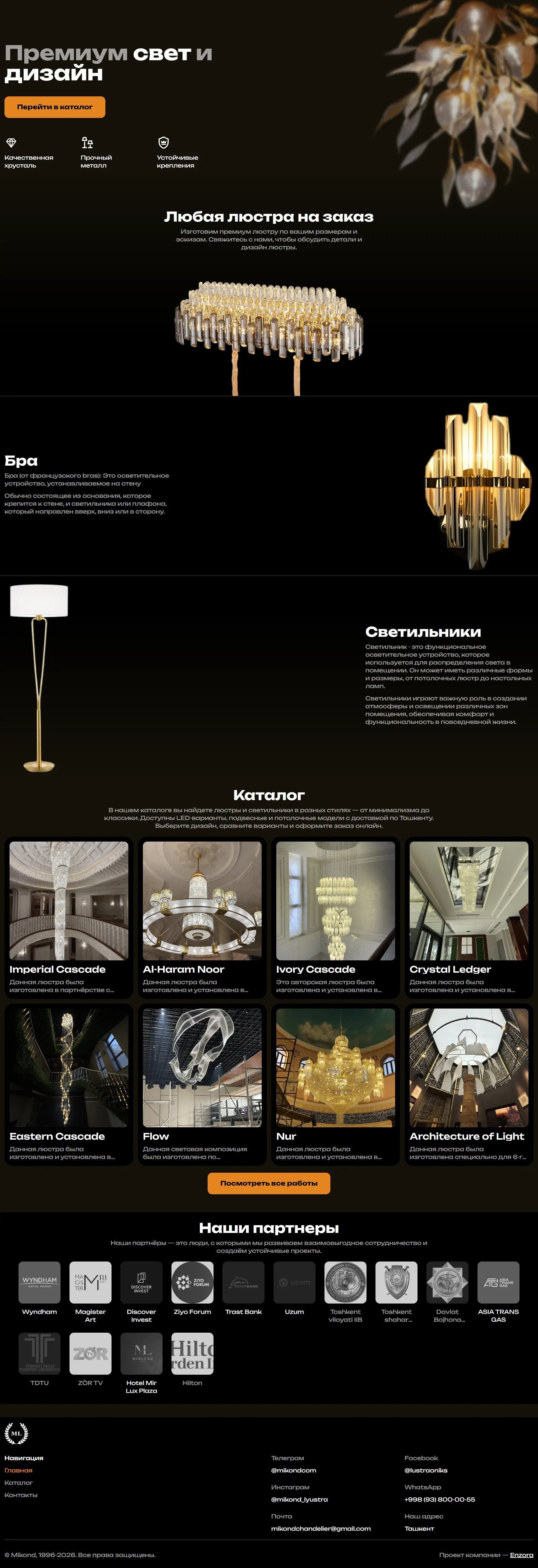
The website is organised around completed projects rather than product listings. A dark first screen with the headline “Premium Lighting and Design” sets the tone straight away, next to three pillars of the brand: high-quality crystal, durable metal and secure mounts. Below come the offer to make a chandelier to order, sections on wall sconces and light fittings, a grid of projects and a wall of partners.
Every chandelier in the catalogue leads to its own page with a detailed story of the project, photos in a full-screen gallery and, where filled in, dimensions, materials, weight and video. The Order button asks the visitor to pick a channel, Telegram, Instagram, WhatsApp or a call: on a phone the number is dialled at once, on a desktop a window with the numbers appears.
The interface is written in React, bundled with Vite and keeps its state in MobX, while sections and translations load only when needed. Data on projects and partners is served by Django REST Framework and filled in through the Django admin. All three language versions carry hreflang markup and share one sitemap, and nginx caches the API responses.
A catalogue of completed projects
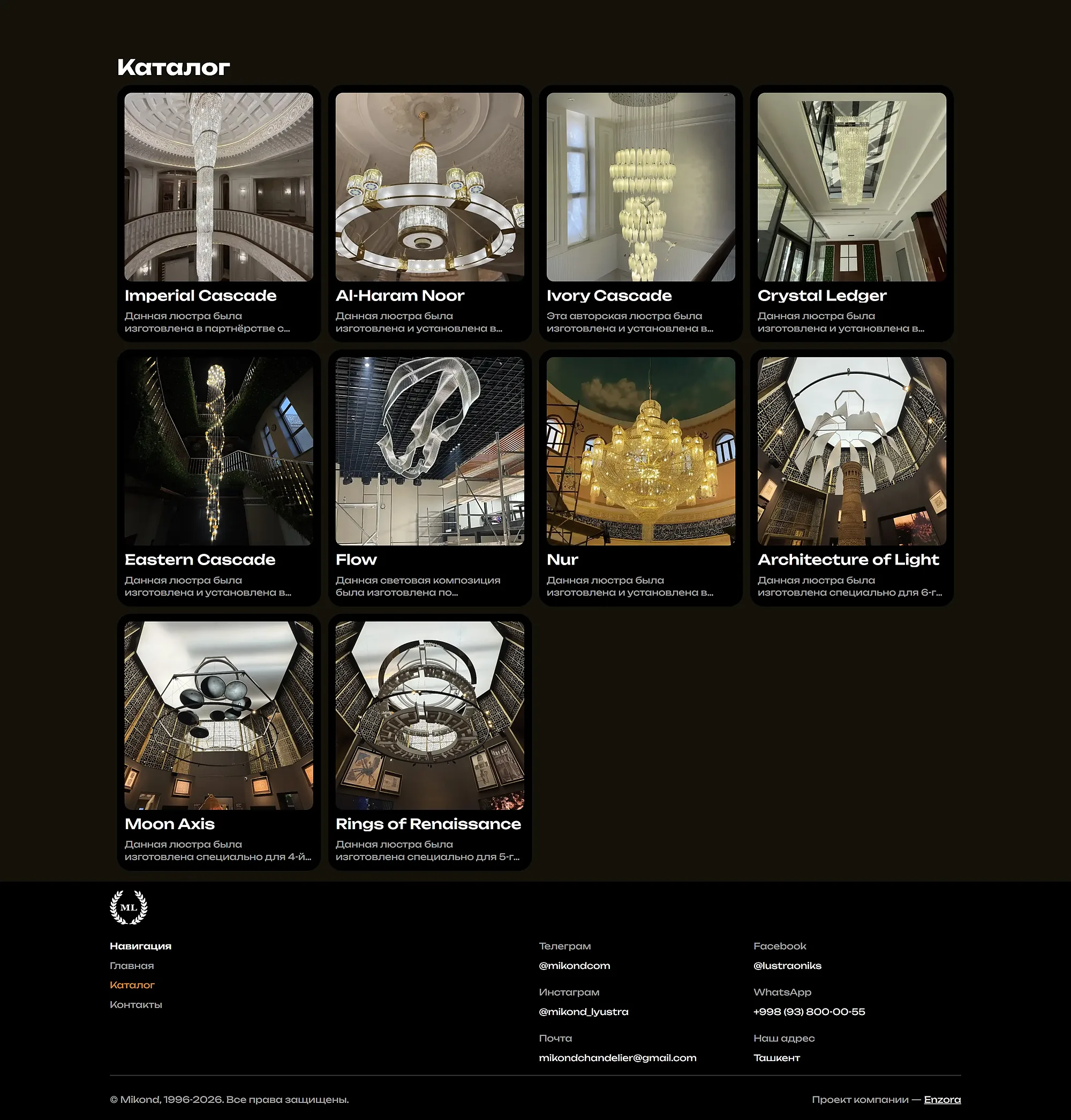
Instead of faceless product cards, the catalogue shows chandeliers with names and places of installation: mosques, the Centre for Islamic Civilisation, a bank lobby, restaurants, a hotel and private homes. The home page features eight projects, and the View all works button opens the rest.
A page for every chandelier
Each piece has its own page with breadcrumbs, a detailed description of the project and fields for dimensions, materials, weight and video. A buyer sees not just the shape of the chandelier but how it looks in a real interior.
Ordering through a preferred channel
The Order button opens a choice of four channels: Telegram, Instagram, WhatsApp or a phone call. On a smartphone the call starts right away, while on a desktop a window with two phone numbers pops up so the client can dial either.
A gallery with zoom
Project photos open in a full-screen gallery with zoom and swiping. The catalogue grid first shows light previews from the server, and full-size images replace them once loaded, so the page never sits empty while pictures arrive.
Three languages and an SEO base
Each language version has its own address: English at /en/, Uzbek at /uz/ and Russian on the main domain. The versions are linked with hreflang tags, the sitemap lists all nine pages, and titles and descriptions target searches for chandeliers, light fittings and wall sconces in Tashkent.
An admin for projects and partners
New projects, photos, videos and partner logos are added in the Django admin with the Unfold interface. A project appears on the website at once, with no code changes: that is how the NG Hotels lobby joined the catalogue after launch.
Results
The project's key outcomes in numbers.
- +44%Pages per visit
Visitors open more pages per session, moving from the home page to the catalogue and on to individual chandeliers.
- −35%Bounce rate
Fewer people leave from the first screen, since projects, partners and the way to the catalogue are visible at once.
- 4Channels to order
Telegram, Instagram, WhatsApp and a call: the client picks a convenient option right on the chandelier page.
- 16 daysFrom kickoff to launch
It took sixteen days to deliver the design, front end, API, admin panel and three language versions.
Design & interfaces
Key screens and interfaces of the project.
Project tech stack
The stack we used to build the solution for the client's task.
- Python
- Django
- Django REST Framework
- Nginx
- Linux
- React
- Vite
Similar cases
Ready to become the next case?
Tell us about your task — a manager will assemble the team, calculate the estimate and send a proposal within the first hour after the request. No obligations, no drip campaigns.